

### Blog Post:
Thinking about an induction cooktop retrofit in your home? The main question homeowners face is: will you need an expensive electrical panel upgrade to make the switch from gas to induction—and if so, what will it really cost, and what rebates can help offset the bill? This guide gives you plain numbers and step-by-step details before you book an electrician or order an appliance.
Key Takeaways
- About 40% of U.S. single-family homes need a panel upgrade before a standard 40–50A induction cooktop retrofit.
- Panel upgrades average $4,000 (range $3,000–$5,000), but can be much higher for older homes or if rewiring is required.
- Federal and state rebates can cover part of upgrade and retrofit costs—eligibility usually requires replacing a gas stove.
- Quick answer — will you need a panel upgrade?
- Typical electrical requirements for an induction cooktop
- What a panel upgrade actually costs (and why prices vary)
- Full cost breakdown — line items to expect on the electrician’s estimate
- Most common installation challenges and homeowner complaints when switching from gas
- How to assess your home quickly — DIY checks and what to ask an electrician
- Rebates, incentives and eligibility in 2024 — where to look and common rules
- How rebates affect your net cost and what to document
- Timeline and project flow — realistic schedule from quote to cooking
- How to avoid surprises — tips for homeowners before hiring anyone
- Quick FAQ / mythbusting
- Next steps / Call to action
Quick answer — will you need a panel upgrade?
If your home has an older or already full panel, you’ll probably need an upgrade to handle an induction cooktop retrofit. Most induction cooktops and ranges require a Dedicated 40–50A, 240V circuit—more than what many U.S. homes with 100 amp service can deliver alongside other large appliances.
About 40% of U.S. single-family homes need a service upgrade to support an induction cooktop retrofit in 2024.[source] If you don’t have enough open breaker slots or your panel’s main rating is under 150 amps, upgrades become likely. National Electric Code (NEC) compliance and old panel models (like Federal Pacific or Zinsco) can also trigger required replacement.

Typical electrical requirements for an induction cooktop
Standard induction cooktops usually need:
- Dedicated 40–50A, 240V circuit
- Properly sized copper wire (usually 8 or 6 gauge)
- Dual-pole breaker (40–50A)
- Permit and inspection for the new circuit and, if needed, the panel upgrade
How to confirm your home’s readiness:
- Check your main panel’s amperage rating (look for a number like “Main: 100” or “Main: 200”)
- Count open breaker slots
- Review panel age and brand (look for warning labels or recall lists)
- Ask an electrician to run a load calculation based on all your appliances (required by code)
Most research assumes a standard 40–50A induction range installation when determining upgrade rates.[source]
What a panel upgrade actually costs (and why prices vary)
The most common upgrade—moving from a 100A to a 200A service for an induction cooktop retrofit—averages around $4,000, with typical range between $3,000 and $5,000.[source]
- Panel replacement only: $1,000–$2,500 (if simply swapping old for new at same amperage)
- Service upgrade (100A to 200A): $3,000–$5,000 (includes new panel, meter, wiring, inspection)
- Subpanel addition: $800–$2,000 (for added circuits if the main panel can’t expand, but total service unchanged)
- Major rewiring/service entrance: $8,000+ (if panel is in poor shape, wrong location, or home wiring is unsafe)
Costs swing on home age, location, regional labor rates, panel location, wiring condition, and whether the utility needs to update outside service lines or transformers.
For more on upgrade process and risks, see our internal guide on checking electrical panels for retrofit compatibility.
Full cost breakdown — line items to expect on the electrician’s estimate
Expect to see these line items on your electrician’s quote for an induction range installation:
- Panel and breaker hardware
- Labor (removal, installation, wire work, coordination with utility)
- Electrical permit and municipal inspections
- Service-entrance cable or conduit for larger upgrades
- Panel moving (if current location is noncompliant)
- Subpanel addition if needed only for extra circuits
- Potential rewiring or remediation if old/unsafe wiring found (like knob-and-tube)
Example price points for 2024:
- Subpanel addition: $800–$2,000
- Moving an electrical panel: +$800–$3,000
- Major rewiring: $8,000+, sometimes $10,000–$30,000 for historic homes with knob-and-tube wiring
Some jobs balloon in cost due to code updates, utility upgrades, or running wiring in finished spaces. For more details, see our retrofit budgeting guide.
Most common installation challenges and homeowner complaints when switching from gas
Switching to induction brings real-world complications:
- Discovering you need a full service or panel upgrade after getting an appliance quote
- Waiting weeks for a licensed electrician or city permit during busy local periods
- Surprise expenses for subpanels, moving panels, wiring remediation
- Sticker shock—for example, one homeowner spent ~$3,300 for a 200A panel upgrade for their induction switch[source]
- Time spent learning the new appliance operation or having to replace some cookware
Factor these risks into your project timeline and get several transparent, detailed quotes. For more on induction pros and cons, check our roundup: induction versus gas range pros/cons.
How to assess your home quickly — DIY checks and what to ask an electrician
Before calling a pro, do this checklist yourself:
- Locate your main panel—read its total amperage rating
- Count the number of open breaker slots
- Check for clear labeling of all circuits (if missing, expect extra labor)
- Look for old knob-and-tube wiring or signs of an outdated panel (rust, recall brands)
Questions to ask your electrician:
- Can a load calculation confirm my ability to add a 40–50A circuit for induction?
- Would a subpanel suffice, or do I need a full service upgrade?
- Will the panel location and grounding pass local code and utility inspection?
Approximately 40% of homes will require a panel upgrade to install a typical induction cooktop.[source] For a deeper dive on assessment, see our DIY panel assessment checklist.
Rebates, incentives and eligibility in 2024 — where to look and common rules
Rebates and incentives can dramatically cut the net cost of your induction cooktop retrofit, especially when switching from gas. The largest rebates come from:
- Federal government (DOE Home Upgrades rebates)
- State and local utility programs
- Occasional manufacturer and big-box retailer incentives
Common eligibility requirements:
- You are replacing an existing gas or dual-fuel range
- First-time electrification in your kitchen
- New construction (in some cases)
- Proof of licensed installation and valid permits is typically required
For current DOE rebate details, visit energy.gov home upgrades and your state energy office. Eligibility and paperwork can vary—get pre-approval and keep all documentation.
We track new incentives on our rebate center page and have seen many local utilities layering on extra discounts.
How rebates affect your net cost and what to document
Let’s look at the real math for an induction range installation:
| Item | Example Cost | Minus Rebate | Net Cost |
|---|---|---|---|
| Basic induction cooktop | $1,600 | –$500 | $1,100 |
| 200A panel upgrade | $4,000 | –$1,200 | $2,800 |
| Total | $5,600 | –$1,700 | $3,900 |
Always confirm your eligibility and submit:
- Receipts and serial numbers (for appliance and electrician labor)
- Proof of gas appliance removal/replacement
- Photographs of installation and new panel (if applicable)
- Copies of permit and inspection sign-off
- License details for all contractors
- Any pre-approval numbers from program administrators
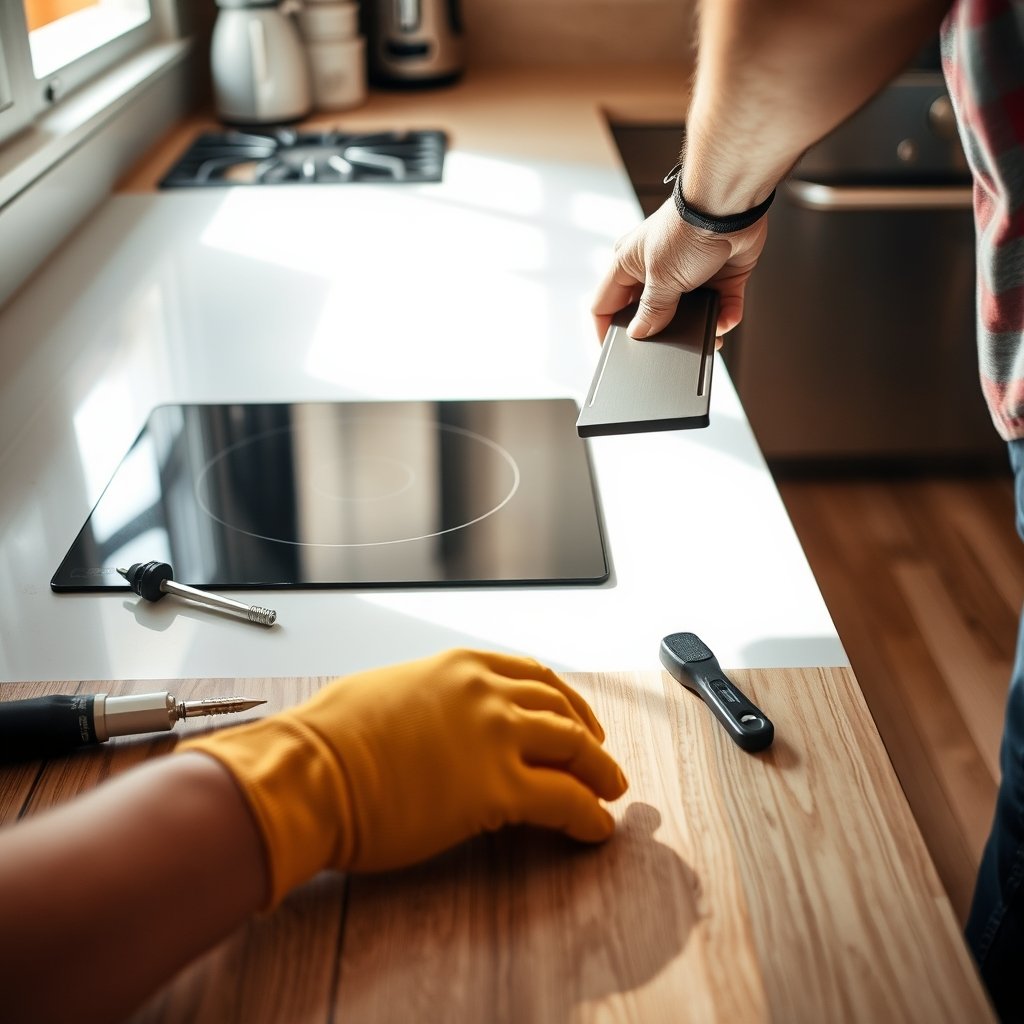
Timeline and project flow — realistic schedule from quote to cooking
Here’s what to expect from start to finish:
- Site assessment and panel inspection (1–3 days)
- Get multiple licensed electrician quotes with written load calculation (1–2 weeks)
- Apply for rebates and local permits (1–4 weeks depending on jurisdiction)
- Panel and wiring work (1–5 days; subpanels can be same day, full upgrades take longer)
- Induction cooktop/range installation (same day as wiring, if ready)
- City inspection and approval (up to several days/tied to permit office scheduling)
Most subpanel additions happen in a day. But complex panel upgrades or rewiring—especially in older homes—can add days or weeks to your project and increase your final cost. For project management pointers, see our kitchen electrification roadmap.
How to avoid surprises — tips for homeowners before hiring anyone
Nobody likes last-minute budget busters. Here’s how to limit stress:
- Get at least three quotes from licensed electricians experienced with induction range installation
- Ask for a written load calculation and clear permit plan upfront
- Ensure you have rebate pre-approval in writing (with checklist of required documents)
- Request a timeline for permit and inspection steps
- Discuss appliance specs and confirm amperage needs—plus any cookware or ventilation concerns
Because about 40% of homes need a panel upgrade and the average upgrade cost hovers around $4,000, early verification saves headaches.[source] For best results, see our full guide to hiring an electrician for electrification.
Quick FAQ / mythbusting
Do I have to replace all my cookware for induction?
Most induction cooktops need magnetic cookware—if a magnet sticks to the bottom, it likely works. Cast iron and most stainless cookware is induction-compatible. Some aluminum and copper pans aren’t.
Is induction cooking actually faster than gas?
Yes, generally. Induction surfaces can bring water to a boil in under half the time of a typical gas burner and are much more energy-efficient overall.
Can I just plug in a 120V portable induction unit?
Yes, but those units are lower powered, usually around 1,800 watts—fine for a single pot, but not a full range replacement. Standard “slide-in” induction ranges nearly always require a 240V, 40–50A circuit.
How common are induction cooktops in the US?
Only about 3% of U.S. homes have an induction cooktop, but nearly 70% of people shopping for a new range are considering induction.[source] Demand is rising rapidly, which may mean longer wait times for installation in some regions.
Can I skip permits or licensed electricians to save costs?
No. Inspections and licensed work are almost always required for panel upgrades and new 240V circuits. Skipping permits may void insurance or make you ineligible for rebates.
Next steps / Call to action
Ready to move forward? Here’s your quick action checklist for any induction cooktop retrofit or induction range installation:
- Check your panel’s main amperage and count open breaker slots
- Gather appliance specification sheets and total amperage required
- Get 2–3 written, licensed electrician quotes including permit and inspection costs
- Visit local, state, and federal rebate portals (like energy.gov home upgrades) or our rebate center
- Apply for rebate pre-approval before ordering your cooktop or starting panel work
- Plan your schedule from quote to inspection to avoid last-minute delays
With about 40% of homes requiring a panel upgrade and average upgrade costs at $4,000, a quick DIY panel check before placing any appliance order could save you real time and money. Curious if your panel will pass? Start your assessment or find more pro tips in our Complete Induction Retrofit Guide.
—